Log Home Maintenance
Log homes are the quintessential dream of High Country living. Their rustic elegance perfectly matches the rugged beauty of the Blue Ridge Mountains. However, the very environment that makes living in Boone, Blowing Rock, or Banner Elk so desirable—our stunning winters, humid summers, and high altitude—poses unique challenges to wood structures.
Without regular maintenance, a log cabin can quickly fall victim to the elements. For home buyers or current owners in Watauga, Ashe and Avery Counties, understanding these local threats is the key to preserving your property’s value and structural integrity.
As a local home inspector, I have seen firsthand how proactive care can prevent tens of thousands of dollars in restoration costs down the road. Here is the ultimate guide to High Country log home maintenance.
1. The Annual Inspection: A Seasonal Ritual – Log Home Maintenance
The most crucial step in log home care is also the simplest: look at your house. You should perform a thorough walkthrough twice a year, ideally in spring (after the snow melts) and autumn (before the freezing rain begins).
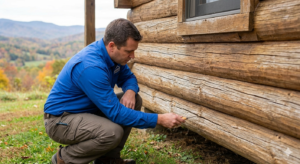
What to look for:
-
Log “Checks” (Cracks): Most logs crack naturally as they dry; this is called checking. However, if a check is wider than 1/4 inch or is facing upwards, it becomes a funnel for rainwater. These upward-facing checks must be sealed.
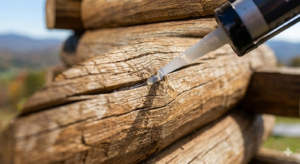
Upward-facing cracks must be sealed to prevent water from pooling inside the log. -
The Splash Zone: Pay close attention to the bottom three rows of logs. They receive the most punishment from roof runoff and ground splash. Look for signs of dark staining, moss, or softness.
2. Moisture Control: The Enemy of Wood – Log Home Maintenance
In the humid mountains of Western NC, moisture is your greatest enemy. If logs stay damp, they will rot.
-
Gutters and Overhangs: Your roof system must handle the High Country’s heavy rains. Gutters should be free of debris. Roof overhangs should ideally be at least two feet to shield the walls.
-
Vegetation: Never let rhododendrons, vines, or landscaping touch your logs. These trap moisture against the wood and provide a bridge for insects. Maintain a “breathing zone” of at least 18 inches between vegetation and your walls.
-
Grading: Ensure the ground around your foundation slopes away from the cabin. You want rainwater to drain off into the yard, not pool around your bottom logs.
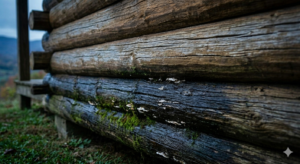
If your logs look like this, they are actively absorbing water. This is a primary cause of log rot in Western North Carolina.
3. Staining and UV Protection: Higher Altitude Means Higher Risks – Log Home Maintenance
Boone and Banner Elk sit at a significantly higher altitude than the rest of the state. This means the UV radiation from the sun is far more intense. The sun will break down a log home’s protective stain faster here than in Charlotte or Raleigh.
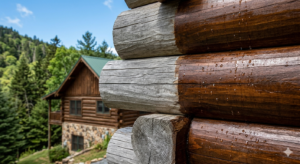
How often to stain?
In the High Country, south and west-facing walls are hammered by the sun and might need re-staining every 2–4 years. Shaded walls can often go 5–7 years.
The “Water Bead” Test
Not sure if it’s time to stain? Spray your logs with a hose. If the water beads up and rolls off, your seal is good. If the water soaks into the wood and turns the log dark, you are overdue for a coat of high-quality UV-resistant stain.
4. Insects: Keeping Out the Pests – Log Home Maintenance
Log homes are comfortable for you, but they can also be comfortable for pests. Our region has a few specific insects you need to watch for:
-
Carpenter Bees: Look for perfectly round, 1/2-inch holes, usually on the underside of logs, eaves, or porch beams. While they don’t eat the wood, they tunnel through it, creating paths for rot.
-
Carpenter Ants: If you find piles of sawdust (frass) near your logs, you might have an infestation. Ants are attracted to damp, soft wood—a warning sign that you might have a leak somewhere.
-
Termites: Though less common at higher elevations than in the Piedmont, termites are still present in NC. They destroy wood from the inside out, making them hard to detect without a professional inspection.
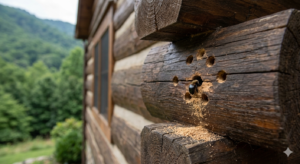
Don’t ignore the sawdust. Carpenter bees and other wood-boring insects can create deep galleries that lead to moisture intrusion and rot.
Log Home Maintenance Conclusion: Don’t Wait for a Major Repair – Log Home Maintenance
Log homes require constant vigilance, but the reward of living in a mountain cabin is worth the effort. By performing annual inspections and addressing issues early, you can enjoy your High Country dream home for a lifetime.
If you are buying a log home in Boone, Blowing Rock, or Banner Elk, or are concerned about the status of your current logs, contact us today to schedule a comprehensive, specialized log home inspection. We know the High Country, we know wood, and we know what to look for.
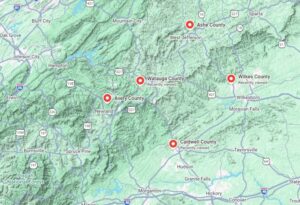
Schedule Your Home Inspection HERE.
For more information about your home inspection click HERE.
Check out why it is essential get a thorough Log Home Inspection in the NC High Country HERE.
Check out more on Log Homes from InterNACHI HERE.