
Thermal Imaging NC – Why this Inspection in the NC High Country Changes Everything – Thermal Imaging NC
Buying or maintaining a home in the North Carolina High Country comes with an undeniable mountain charm, but our distinct environment also brings unique structural challenges. From heavy winter snows and freezing temperatures in Boone to intense humidity and driving wind-driven rains across Blowing Rock and Banner Elk, mountain homes take a beating. Standard visual inspections are foundational, but they can only see what is visible on the surface of drywall, wood, or siding.
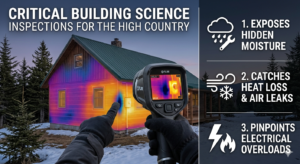
That is where advanced building science completely shifts the narrative. Utilizing high-resolution infrared technology through a professional thermal imaging home inspection in NC allows an inspector to peer behind the finished surfaces of a home. It reveals hidden thermal anomalies, identifying problems long before they manifest as costly structural repairs, toxic mold growth, or catastrophic failures.
The Science of Thermography in Mountain Environments – Thermal Imaging NC
Infrared thermography converts invisible thermal radiation into a highly detailed visual map. Every material possesses a distinct thermal mass and emissivity rating, radiating heat in predictable patterns. When a building component behaves abnormally—such as a section of ceiling insulation holding moisture or an electrical panel breaker overloading—it changes temperature. This shift is captured instantly by an infrared lens.
The core physics rely on calculating heat transfer differences. Consider the basic heat transfer formula for conductive energy loss through building envelopes:
In this relationship, Q represents the total heat transfer rate, U is the overall heat transfer coefficient (the inverse of the R-value), A is the surface area, and ΔT is the temperature differential between the interior conditioned living space and the harsh outdoor mountain environment.
During a cold High Country winter or a hot, humid summer afternoon, the ΔT becomes highly pronounced. This stark contrast makes missing insulation, unsealed top plates, or structural bypasses glow vividly on an inspector’s screen, offering undeniable diagnostic proof that a standard visual inspection simply cannot match.
1. The Hidden Enemy: Mountain Moisture & Condensation – Thermal Imaging NC
In the Appalachian mountains, moisture is a persistent threat. Driven by seasonal humidity patterns, heavy rain events, and the freeze-thaw cycles common to high altitudes, moisture finds its way into building assemblies through minute gaps. Water has an exceptionally high thermal capacity compared to dry building materials like gypsum board, wood framing, or fiberglass insulation. This means wet materials change temperature much slower than dry ones.
During an inspection, damp areas appear as distinct, cool geometric shapes or irregular patterns (often resembling fingers or downward plumes) behind walls or ceilings. Catching these early protects homeowners from:
-
Hidden Roof Leaks: Water traveling along rafters or under felt roofing paper before it drips onto a ceiling can remain hidden from view for months.
-
Foundation Ice Damming: Snow melting on a roof and refreezing at the uninsulated eaves pushes water backward under shingles, causing leaks that thermal cameras map effortlessly.
-
Sub-Surface Plumbing Leaks: Micro-leaks inside finished bathroom walls, beneath modern tile showers, or around supply lines can be located without invasive drywall removal.
2. High Energy Bills: Detecting Heat Loss & Missing Insulation – Thermal Imaging NC
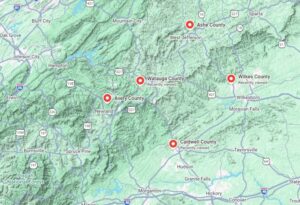
Heating a home in Watauga, Ashe, or Avery County during winter months can be incredibly expensive. Many older mountain cabins or quickly executed renovations feature gaps in their thermal envelopes. A thermal camera immediately exposes building defects that waste energy:
-
Settled or Missing Insulation: Wall cavities where fiberglass batts have slumped over decades or areas in the attic skipped during construction stand out instantly.
-
Severe Air Infiltration: Pervasive drafts around window casings, entry doors, knee walls, and unsealed recessed lighting fixtures appear as dark streaks of cold air penetrating the conditioned space.
-
Conditioned Crawlspace Failures: Uninsulated band joists and poorly sealed sill plates let cold air flood the floor systems, making interior floors uncomfortably cold.
3. Invisible Fire Hazards: Overloaded Electrical Circuits – Thermal Imaging NC
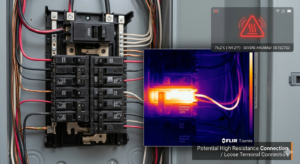
Electrical safety is an essential component of a thorough home inspection. When electrical current flows through a circuit with high resistance—caused by loose terminal connections, corroded wiring, undersized conductors, or failing breakers—heat is generated via localized electrical resistance. This condition is a primary cause of residential building fires.
Because electrical components are housed behind dead-front covers or tucked away inside junction boxes, standard visual inspections cannot easily find these hot spots. Using an infrared camera under loaded circuit conditions allows an inspector to look safely at a service panel and spot an overheating component immediately. The thermal camera shows a failing breaker as a bright, glowing white point of thermal energy against the cool blue background of properly functioning breakers. Thermal Imaging NC.
What Thermal Cameras Can and Cannot Do – Thermal Imaging NC
To set proper expectations, it is helpful to clarify the operational limits of thermographic diagnostics. Home buyers occasionally ask if thermal imaging allows an inspector to “see through” walls like an X-ray machine. It does not. Instead, it functions as a highly sensitive surface temperature sensor that requires a trained eye to interpret properly.
| What Thermal Imaging CAN Reveal | What Thermal Imaging CANNOT Do |
| Active moisture plumes behind drywall, flooring, or wood paneling. | See through walls or display solid structural framing members directly. |
| Anomalous heat signatures indicating overloaded wiring or loose connections. | Identify non-active or completely dry historic water stains. |
| Precise gaps, voids, and settled areas within insulation boundaries. | Identify specific toxic mold species or biological agents without physical testing. |
| Hidden bypasses leaking conditioned air into unconditioned spaces. | Operate effectively without an adequate indoor/outdoor temperature difference ($\Delta T$). |
Investing in Clarity for Your High Country Property – Thermal Imaging NC
Whether you are purchasing a modern custom estate in Banner Elk, an older rustic cabin near the Blue Ridge Parkway, or managing a commercial asset in Boone, relying only on traditional inspection methods leaves too much to chance. Protecting your investment requires clear, actionable data. Choosing a comprehensive thermal imaging home inspection in NC ensures that hidden defects are identified before closing, providing true peace of mind and protecting your wallet from unexpected, expensive surprises. Thermal Imaging NC.
To learn more about thermal imaging technology, visit FLIR’s website HERE
To book your Thermal Imaging NC Infrared Scans to your Home Inspection, visit our website booking page HERE
Thermal Imaging NC – it matters!